VantaCon was a blast. Hope to see you all soon around the Vanta Community!
👋 Keeping the AI governance conversation going after VantaCon! Hey everyone! Between sessions today, here’s one for your calendar—especially if you’re a startup selling to larger customers. Govern AI and close bigger deals: The startup edition 📅 Tuesday, November 17 | 9am PT / 12pm ET / 5pm GMT I’m joining Sayak Chatterjee, Founding Engineer at Mirror Physics, and Vanta’s Anarghya Vardhana to talk about turning AI governance into something practical: clear answers for buyers, evidence that builds trust, and fewer surprises during security reviews. We’ll cover:
What enterprise buyers want to know about your AI, including data use, oversight, and vendors.
Where ISO 42001, NIST AI RMF, and the EU AI Act fit into the conversation.
Where to start: knowing what AI you use, assigning owners, assessing risk, and documenting the proof.
🎓 Eligible for 1.0 CPE credit when you attend the full live session and respond to all polls. 👉 Register here Already getting AI questions in customer security reviews? Drop one below—I’d love to hear what’s coming up!
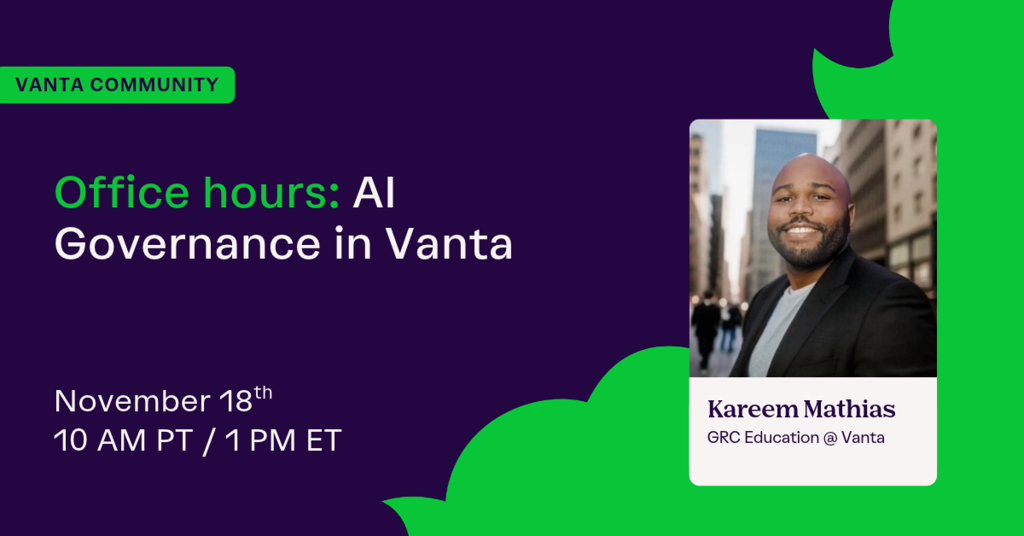
Hello Kareem here 👋 , if you’re enjoying VantaCon then let’s keep the party going with Community Office Hours next week talking all things Ai Gov! Drop a like and I’ll invite you to the conversation happening next week 11/18 1:00pm est, 10:00am pst.
Forwarded from Tightknit in 🔒 private conversation
⏰ Reminder: Office Hours: AI Governance in Vanta is starting in 7 days!
Hi everyone. We’ve had some interesting questions in the channel lately. I’m having this conversation on Ai Governance on 11/18th to talk about the new module and all things Ai Governance. I’ll also answer any kinda question you have. Like this to get a zoom invite directly from me. C.C. Jake T., Rudy M., Griffin N.
Forwarded from Tightknit in Community Events
Office Hours: AI Governance in Vanta
Event
(179 kB)
📆 Office Hours: AI Governance in Vanta
Wednesday, November 18, 2026 6:00 PM - Wednesday, November 18, 2026 7:00 PM
Make AI governance your advantage instead of a fire drill. If you’ve been wondering where to start, whether you’re doing enough, or how to explain it all to your auditor, you’re not alone. Kareem M., Vanta’s GRC expert and educator, is hosting live office hours to discuss all-things AI Governance, and what Vanta is doing about it. Ask anything, compare notes with peers, and walk away feeling ready to act. This one’s on Zoom. See link above in this post.

A few ways. I have an office hours coming up on 11/18 where I take questions from our customers. However we can hop on a call and I can walk through it.
Happy to keep the discussion here! Vanta can absolutely support your internal audit program by organizing evidence, monitoring controls, and giving reviewers a structured way to assess supporting information. The distinction I’d make is between keeping the ISMS continuously audit-ready and conducting the internal audit itself. Alongside the evidence in Vanta, you’d want to demonstrate the audit’s scope and criteria, who performed it and how impartiality was maintained, the results reported to management, and any corrective actions. If that assessment is happening and you’re using Vanta to support and document it, that’s how I’d describe the approach. I’d be cautious about presenting automated monitoring and passing tests alone as fulfilling the internal audit requirement. I haven’t personally taken that specific approach through surveillance, so I can’t offer a firsthand acceptance story, but I’m happy to help with the Vanta workflow!
Hey! I haven’t personally conducted an ISO 27001 internal audit using that arrangement, so I’ll leave firsthand experiences with certification bodies to others here. Where I can help is the Vanta side: organizing and mapping supporting evidence, making the scope and audit period clear, and walking through audit setup and reviewer access so whoever conducts the internal audit can find and assess what they need. For the independence question, I’d raise your proposed arrangement with your certification body ahead of January, particularly how the areas you own would receive an impartial assessment. I wouldn’t assume Legal and Finance signing off on the results is sufficient by itself. Happy to help you work through the Vanta setup!
Thank you. And yes, emergency questions are the best questions.
👀 You may have noticed a little name change around here… Hello GRC. GRC-World is now GRC. A little less “GRC theme park,” a little more “here’s exactly where to ask your question.” The idea is simple: if you have a GRC question, this is the place to ask it, and I’m here to help. I’m Kareem, and I specialize in GRC, Identity Governance, and AI Governance. Whether you’re untangling a framework requirement, preparing for an audit, sorting out access reviews, or figuring out AI governance, I enjoy working through real problems with you. Drop your question here and tag me, Kareem M.. Big questions, small questions, “I feel like I should already know this” questions—all welcome. What’s been keeping you and your risk register up at night? 👇
Hi Jake, a few points on this: I took a close look at your proposed pentest plan and evidence strategy. While I understand the intent behind testing in staging to protect production stability, this approach introduces significant audit, timing, and commercial risks that you should address before kicking off testing with your new firm. Here is a breakdown of where this plan will likely run into trouble and how to restructure it for a clean audit.
1. The Evidence Plan Won't Hold Up Under Rigorous Audit
Internal attestations carry minimal weight: An internal memo or CPO sign-off is categorized as management inquiry—the weakest form of audit evidence. Auditors look for independent, objective verification; management statements alone will not satisfy them.
Code parity is not runtime security parity: Matching GitOps and IaC commit IDs proves that identical code and infrastructure definitions were deployed, but it does not prove identical runtime security. Staging environments routinely differ from production in critical areas:
Over-permissioned service accounts and developer IAM access.
Different network edge defenses (WAF rules, DDoS protection, ingress/egress filtering).
Mock data and stubbed third-party APIs that mask real-world injection vectors or data exposure risks.
Live configuration drift that IaC files don't reflect.
2. Multi-Cloud Scope Cannot Be Proxied
Each production cloud must be evaluated: If AWS, GCP, and Azure all host production assets or customer data, they are all within your SOC 2 System Boundary (Section III). You cannot sample or substitute one cloud for another.
Workload-to-cloud risks are platform-specific: Testing your application exclusively in GCP will not validate how that application interacts with AWS IAM roles, Azure managed identities, or cloud-specific metadata services (e.g., AWS IMDSv2 vs. GCP metadata). Critical attack vectors like Server-Side Request Forgery (SSRF) and privilege escalation behave entirely differently across these providers.
3. Timing and the Type II Lookback Window
Remediation buffer: A SOC 2 Type II audit evaluates controls across a continuous observation window (typically 6 to 12 months). If the pentest identifies Critical or High findings near the end of your audit period, you must remediate and retest them before the window closes. If findings remain open or unverified at cutoff, the auditor must log a control exception under CC7.1/CC7.3. Plan for testing to conclude at least 45 to 60 days before your period ends.
Strict annual cadence: If your internal security policy mandates an "annual" pentest, the auditor will check the calendar gap between your last report and this one. Letting scope logistics push you past the 365-day mark triggers a policy compliance failure regardless of the test results.
4. SOC 2 Is Binary, Not a Maturity Score
Roadmaps don't replace operational controls: Frameworks like NIST CSF allow for maturity scoring, but SOC 2 Type II is an attestation of operational effectiveness during the review window. Trying to engineer workarounds creates audit exceptions, which will appear directly in your final report.
Enterprise buyers look past the SOC 2: Enterprise procurement teams routinely require the actual Pentest Executive Summary and Retest Letter under NDA alongside your SOC 2. If a customer’s security team sees staging listed as the sole target in scope, it will immediately raise red flags and delay contract execution.
Recommended Next Steps
Pre-clear the plan with your auditor today: Write a brief, one-page scope document outlining the proposed environment split and ask your SOC 2 auditor directly: "Will this scope satisfy our testing criteria for CC7.1/CC7.3, or will it result in an audit finding?" Get their written consensus before paying the vendor.
Test Production safely: Reputable pentest firms test live production environments daily without disruption. Establish strict Rules of Engagement (RoE): test during low-traffic windows, exclude destructive actions (e.g., bulk deletes or billing runs), and provide dedicated test accounts seeded with synthetic data.
Use a hybrid approach if necessary: If deep exploitation must occur in staging to protect uptime, keep Production explicitly in scope for non-destructive reconnaissance, configuration reviews, and perimeter testing. Ensure the pentest firm explicitly states in their executive summary that staging was used alongside production by design to safely simulate deep application exploitation.